Have you ever picked up a paintbrush or a pencil, felt super excited, but then hated your drawing? You are not alone! Many adults want to be creative, but they run into problems. Maybe your drawings look flat, your paint colours look like a muddy brown mess, or you just cannot draw what is in your head.
When you get stuck, it is normal to want help. might you wonder: Are art classes for adults actually worth the money, or should you just watch free videos on YouTube?
Walking into an art studio can feel scary, especially if you have not drawn anything since you were a kid. You might worry about the cost, finding the time after work, or feeling embarrassed in front of others. Let us look at how art classes work, how they can help you, and if they are right for you.
What Are Adult Art Classes and Why Do They Matter?
Adult art classes are structured learning programs designed specifically for mature students, ranging from absolute beginners to advanced hobbyists. Unlike school art classes from your childhood, these programs focus on choice, personal growth, and practical techniques that match adult learning speeds. They cover a wide range of media, including oil painting, acrylics, watercolours, charcoal sketching, and life drawing.
Investing in proper guidance matters because art is not just a talent you are either born with or without. It is a collection of learnable skills, like playing an instrument or learning a new language. Structured lessons matter because they take the guesswork out of the process. Instead of wasting hours trying to figure out why a portrait looks skewed, a teacher can point out the exact rule of proportion you missed within seconds.
The Core Challenges of Learning Art on Your Own
Learning to draw or paint using only internet tutorials is incredibly common today, but it comes with distinct hurdles that often cause people to give up early.
The Trap of Free Video Tutorials
The biggest issue with free online videos is that they lack two-way communication. A video can show you what a professional does, but it cannot see what you are doing wrong. If you hold your pencil with too much tension or mix your paints with too much water, the video will keep playing regardless. This absence of live feedback makes it easy to repeat mistakes until they become hard habits to break.
Information Overload and Broken Learning Paths
When you search for drawing tips online, you see millions of search results. One creator tells you to start with shapes, another tells you to focus on shading, and a third insists you need expensive supplies. Without a clear path, you jump from one random exercise to another. This lack of structure leads to gaps in your foundational skills, leaving you frustrated when complex projects do not turn out well.
Important Facts and Insights About Group Learning
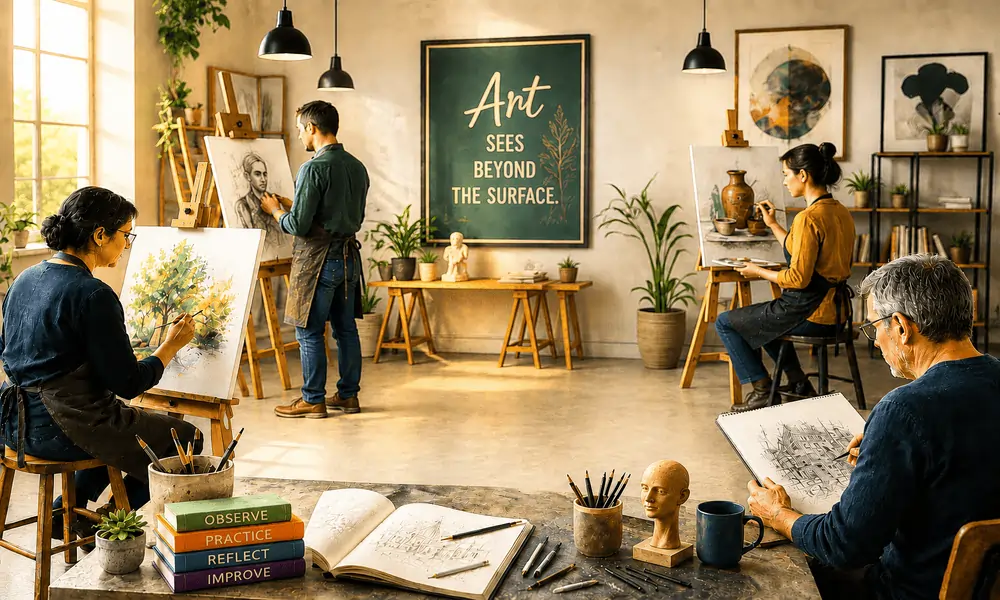
There is a unique dynamic that occurs inside a physical art studio that you simply cannot recreate in your living room. Group learning offers surprising benefits for your focus and speed of improvement.
- The Power of Seeing Other Approaches: In a studio class, you are surrounded by people working on the same project but solving problems differently. Seeing how a classmate handles a difficult shadow or mixes a unique skin tone expands your own creative vocabulary.
- A Dedicated Creative Space: Your home is full of distractions like laundry, family responsibilities, and screens. A studio space forces you to unplug and focus completely on your canvas for a solid block of time.
- Healthy Accountability: Knowing you have a scheduled session each week encourages you to show up and practice consistently, preventing the creative block that happens when art supplies are tucked away in a closet.
Pros and Cons of Structured Art Classes
To decide if art classes are right for you, it helps to look at both the benefits and the things you should consider before joining.
The Benefits
The biggest advantage is rapid skill growth. Under expert eyes, you learn the mechanics of art, such as perspective, colour theory, and tonal values, in an orderly sequence. You also get immediate troubleshooting when something goes wrong on your canvas. Beyond the technical growth, these spaces offer a wonderful sense of community, connecting you with other locals who share your creative interests.
The Drawbacks
The main considerations are financial and logistical. Quality courses require an upfront financial investment, and some expect you to purchase your own starter kits. There is also a fixed time commitment. If your work or family schedule changes constantly, committing to a specific weeknight or weekend block can be a challenge.
Practical Solutions for Different Budgets and Schedules
If you want to transition into formal learning but feel hesitant about the commitment, you do not have to jump straight into a year-long program. There are pathways designed to fit different lifestyles.
Casual Workshops and Short Courses
For those short on time, short courses running for four to six weeks are an excellent entry point. They focus on specific skills, like introduction to charcoal or fluid acrylics. This allows you to test the waters without a major commitment.
Casual Studio Sessions
Many studios offer flexible session information where you can book individual spots based on your availability. These casual options provide access to studio space and professional tools without requiring you to attend every single week consecutively.
Expert Recommendations for Fast-Tracking Your Skills
Professional art educators emphasise that real improvement comes from training your brain to see things as they actually are, rather than how you think they look.
Experts recommend starting your journey with black-and-white mediums like charcoal or graphite before moving on to complex colours. Mastering tonal value (the lightness or darkness of a colour) is eighty per cent of the battle in making an object look three-dimensional. Once you understand how light hits a form using simple grey tones, learning how to handle oil or acrylic paint becomes substantially easier.
Actionable Steps to Improve Your Art Today
If you want to start improving your drawing and painting skills immediately, implement these three practices into your routine:
- Draw upside down: Take a line drawing, turn it completely upside down, and try to copy it. This trick turns off the left side of your brain, which wants to name objects, forcing you to look only at lines, angles, and shapes.
- Limit your colour palette: When painting, do not use twenty different tubes of paint. Stick to a limited palette of just three primary colours plus white. This forces you to learn how to mix clean colours and keeps your artwork looking cohesive.
- Squint at your subject: Squinting your eyes blurs out small details and reveals the core shapes of light and shadow. If you get the big shapes of light and dark right, your drawing will look convincing, even if the fine details are rough.
The Long-Term Benefits of Group Art Classes
Enrolling in a regular course delivers outcomes that extend far beyond a finished piece of art to hang on your wall.
Heightened Mindfulness and Stress Relief
Engaging in visual art changes your brain wave activity. The intense focus required to match a colour or capture a curve acts as a form of active meditation. This is why so many people are actively turning to art classes as a healthy way to unwind after a demanding workday.
Building Creative Problem-Solving Skills
Art is essentially a series of creative problems to solve. How do I make that object look further away? How do I fix this muddy shadow? The critical thinking patterns you develop while correcting a painting build mental flexibility that carries over into your professional life and daily problem-solving.
Common Mistakes Beginners Make and How to Avoid Them
When starting, avoiding a few psychological and practical traps will save you from unnecessary frustration.
Expecting Perfection Instantly
Many beginners judge their work against pieces created by artists with decades of experience. This mindset kills motivation. Focus instead on personal progression. Compare your drawing today to what you drew last month.
Buying High-End Supplies Too Early
You do not need professional-grade linen canvases or handmade European paints to learn. In fact, expensive supplies often make beginners too scared to make mistakes. Use student-grade materials while learning so you can experiment freely without worrying about wasting costly resources.
When to Seek Professional Art Instruction
While self-guided practice is great for playful experimentation, there comes a point where an experienced instructor becomes essential for breakthrough growth. If you feel like your art has completely plateaued and you keep making the same errors project after project, you need outside eyes.
An instructor can immediately diagnose issues with your hand posture, perspective lines, or medium application that you are blind to. If you want to move past basic doodles and create artwork you are genuinely proud to display, joining dedicated adult art classes is the fastest and most reliable way to achieve that goal.
Frequently Asked Questions
Q: Can I join an adult art class if I have absolutely no talent or experience?
A: Yes, absolutely. High-quality adult classes are designed assuming you have zero background in drawing or painting. A good teacher breaks skills down into simple, repeatable steps, proving that drawing is a mechanical skill that anyone can master with practice.
Q: What is the difference between online art tutorials and in-person studio classes?
A: The biggest difference is live, real-time feedback. In an in-person class, an instructor can look at your physical artwork, notice mistakes in your technique right away, and physically show you how to correct them.
Q: How many hours a week do I need to commit to see real improvement in my painting?
A: Attending a single two-hour class once a week, paired with just fifteen to twenty minutes of casual sketching at home a few times a week, will yield noticeable improvements within a couple of months.
Q: Why are busy adults searching for creative activities outside of work?
A: Many individuals look for hands-on hobbies to escape digital screens and high-stress routines. Working with physical mediums like paint or charcoal provides a tactile, grounding experience that refreshes the mind and offers a genuine creative escape from daily pressures.
Conclusion
Ultimately, adult art classes are absolutely worth the investment if you want to skip years of frustrating trial and error. While books and videos have their place, they cannot replace the tailored feedback, structured curriculum, and inspiring community found within a real studio workshop. Leaping to join a class turns a lonely, confusing hobby into an exciting, social experience where your skills grow predictably every week. If you are living in Melbourne, Australia, and want a supportive, welcoming environment to start your artistic journey, come visit us at Artreach Collective to discover our upcoming workshops and find your perfect creative outlet.