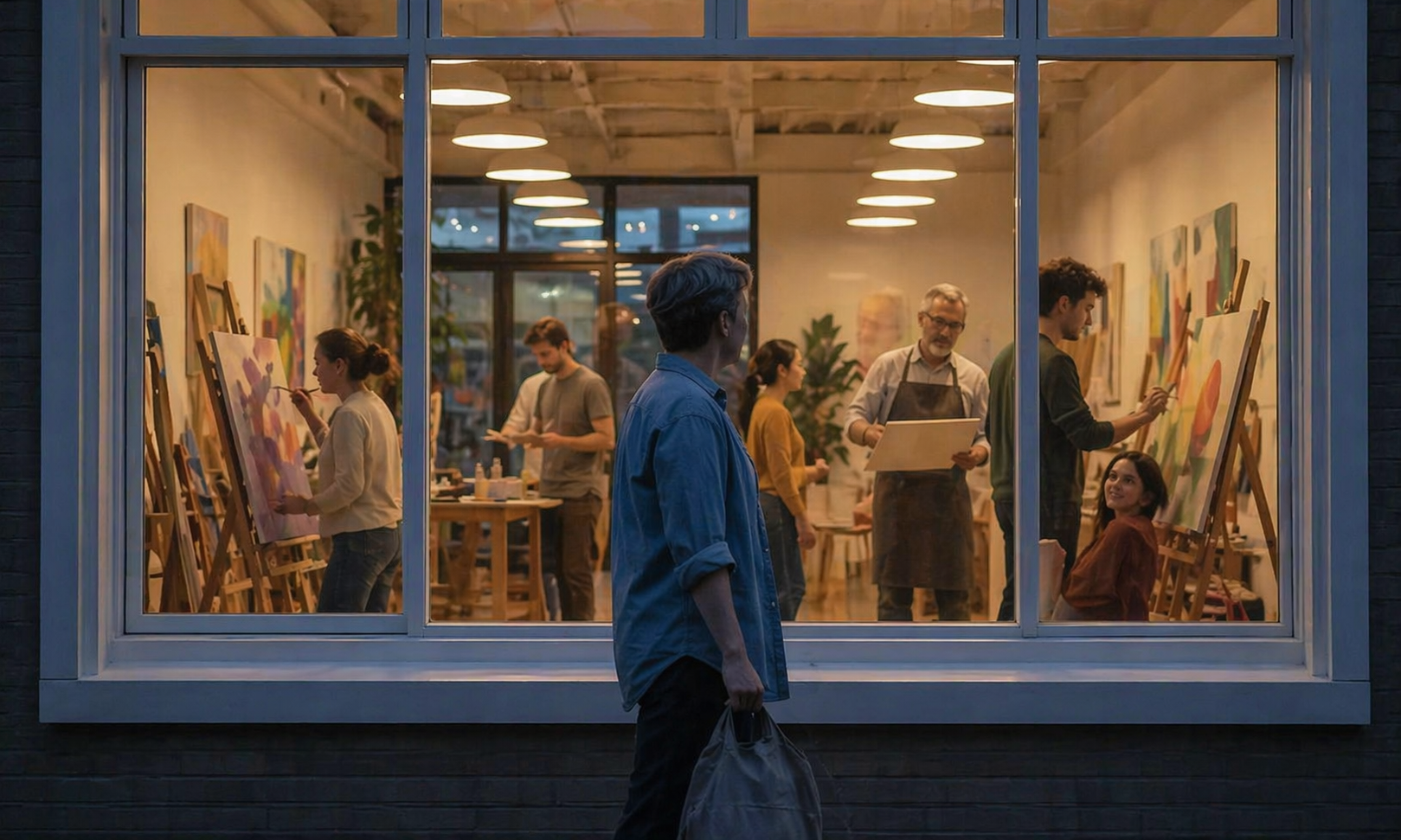
Picture this. You walk past a local studio, and through the window, you see people laughing, painting, sculpting clay, or quietly sketching. Something stirs inside you. You think, “I’d love to do that.” And then, almost immediately, another voice kicks in: “But I’m not talented enough.” “I’m too busy.” “That’s for younger people.” “What if I’m terrible at it?”
And just like that, you keep walking.
This is one of the most common experiences adults have with creative learning. The desire is real. The barrier is almost always psychological, not practical. Research from the National Endowment for the Arts found that millions of adults express interest in arts participation but never take the first step. The gap between wanting to create and actually doing it is wider than most people realise, and it’s not about talent at all.
So why do so many grown adults avoid art classes or workshops, even when a part of them genuinely wants to go? Let’s unpack the real reasons, bust some deeply held myths, and look at what actually happens when adults finally permit themselves to create.
The Real Reasons Adults Stay Away From Art Classes
The Fear of Being Judged (Even in a Safe Space)
The number one reason adults avoid creative workshops is the fear of looking foolish. Unlike children, who typically draw and paint without self-consciousness, adults carry years of internal criticism. Many of us were told at some point by a teacher, a parent, or a peer that we “weren’t artistic.” Those words stick.
This fear of judgment goes beyond worrying about what others think. It’s also about self-judgement. Adults hold themselves to an impossibly high standard. They compare their beginner attempts to finished professional work they see online, and the gap feels humiliating rather than normal.
Psychologists call this experience “creative anxiety.” It is a very real form of performance pressure that prevents people from engaging in expressive activities. Adults are naturally wired to protect their ego, and trying something new, especially something visible like painting or drawing, can feel risky in a way that, say, taking a cooking class does not. This is why many people hesitate to join adult art classes, even though these classes are designed to be supportive, beginner friendly, and focused on building confidence over time.
The “I’m Not Creative” Myth
Here’s a belief that holds back enormous numbers of adults: the idea that creativity is a fixed trait you’re either born with or you’re not. This is simply not true, and science backs that up.
The research behind the concept of “flow” has spent decades studying creativity and found that it is something that can be developed, practised, and nurtured at any stage of life. Creativity is not a talent. It’s a skill set and a mindset.
Art education researchers consistently show that adults who engage in regular creative activity develop stronger problem-solving skills, improved emotional regulation, and greater cognitive flexibility. In other words, making art makes your brain work better regardless of whether the result looks “good.”
The “I’m not creative” belief is a story, not a fact. But it’s a story that keeps millions of adults out of studios and workshops every single year.
Time Pressure and Modern Life
Adults are stretched thin. Between work, family responsibilities, social obligations, and the general exhaustion of modern life, adding something new to the schedule feels impossible. Art classes feel like a luxury, not a necessity.
But here’s what’s interesting. Studies on adult leisure habits show that most people do have pockets of discretionary time, they’re just spending it on passive activities like scrolling social media or watching television. The issue isn’t truly a lack of time. It’s a lack of prioritisation, which itself often connects back to not feeling “worthy” of doing something creative and enjoyable.
When adults reframe art-making as mental health maintenance rather than a hobby, the time equation starts to shift.
Financial Concerns and Perceived Cost
There’s a common assumption that art classes are expensive, that you need to buy a mountain of supplies, and that the whole thing adds up fast. While this can be true for some premium experiences, many community-based art workshops are surprisingly affordable and often provide all materials.
The perceived cost barrier is often higher than the actual cost. Adults talk themselves out of attending before they’ve even looked at the pricing. This mental block, known in behavioural economics as “anticipated regret,” stops people from even exploring their options.
Not Knowing Where to Start
For someone who hasn’t engaged with art since school, the landscape can feel overwhelming. Do you start with watercolour or acrylic? Drawing or pottery? Beginner or intermediate? Online or in-person?
The abundance of choice, combined with no clear entry point, leads to what psychologists call “decision paralysis.” When everything feels equally possible and equally unfamiliar, the easiest choice is to do nothing.
This is why beginner-friendly, structured workshops designed specifically for adults with no prior experience are so important. They remove the decision burden entirely.
What Actually Happens When Adults Start Creating
The Transformation Is Faster Than You’d Expect
Adults who finally leap into an art class almost universally report the same thing: they wish they’d done it sooner. Within just a few sessions, the internal critic quiets down. The focus shifts from “how does this look” to “how does this feel.” And that shift is profoundly liberating.
This connects to the neuroscience of creativity. When you engage in visual art-making, your brain produces dopamine, the same chemical involved in pleasure, motivation, and reward. The act of making something triggers a cascade of positive neurological responses that reduce cortisol (the stress hormone) and promote a calm, focused state of mind.
A study published in the Journal of the Art Therapy Association found that just 45 minutes of creative activity significantly reduced cortisol levels in participants, regardless of their prior experience or skill level.
Community and Connection
One of the most underestimated benefits of attending a physical art workshop is the social dimension. Many adults, particularly those who work remotely or live alone, experience profound loneliness. Creative art classes create a genuine sense of community built around a shared, low-stakes activity.
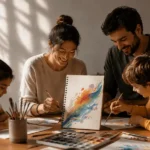
There’s something uniquely bonding about sitting beside someone else who is also figuring out how to make a tree look like a tree. Laughter, encouragement, and shared vulnerability create connections that feel meaningful and real.
Who Art Workshops Are Actually For
Let’s be direct about this: art classes are not just for people who want to become professional artists. They are for anyone who wants to feel more creative, more present, more relaxed, and more connected to themselves and others.
They are for the person who used to sketch as a teenager and stopped. For the busy parent who needs two hours that are genuinely theirs. For the retiree who wants to try something new. For the professional who spends all day in spreadsheets and craves a tactile, analogue experience. For anyone going through a life transition who needs an outlet.
The beauty of adult art education, when it’s done well, is that it meets people exactly where they are.
Frequently Asked Questions
Q: Do I need any experience to join an adult art workshop?
A: No. Beginner workshops are specifically designed for adults who have little or no prior experience. You will be guided step by step, and there is no expectation of prior skill.
Q: What if I’m not “naturally” artistic?
A: Artistic ability is not fixed. It develops through practice and guidance. The goal of most adult classes is self-expression and enjoyment, not technical perfection.
Q: How long does it take to feel comfortable in a class?
A: Most adults report feeling at ease within the first one to two sessions. The right workshop environment is supportive, non-competitive, and encouraging.
Q: Are art classes good for mental health?
A: Yes. Research consistently shows that creative activity reduces stress, improves mood, and supports emotional well-being.
Q: What types of art workshops are best for beginners?
A: Watercolour painting, acrylic painting, drawing fundamentals, and pottery are all excellent entry points for adults.
Taking That First Step in Melbourne
If you’ve read this far, something in you is ready. The hesitation is understandable. The fears are normal. But they don’t have to be permanent.
In Melbourne, there are welcoming, beginner-friendly spaces where adults of all backgrounds come together to create without pressure or judgement. Artreach Collective offers exactly that kind of environment across multiple Melbourne locations, with structured art workshops designed to help adult beginners and children so that they feel comfortable, inspired, and genuinely supported from the very first class.
You don’t need to be talented. You don’t need to have a plan. You just need to show up.