You know that feeling when there’s a storm happening inside your head, but when someone asks “What’s wrong?” you just… freeze? Your mind is screaming, emotions are swirling, but somehow the words to explain it all just won’t come out. If you’ve experienced this, you’re not alone. And if you’re reading this from Melbourne or anywhere else, I want you to know: this isn’t a personal failing. It’s a genuine communication challenge that millions of people face, and there are real, practical ways to work through it.
After 15 years working in mental health and disability support here in Melbourne, I’ve sat with countless people who describe their internal world as “loud” but find themselves unable to articulate what’s happening. Many adults in these situations benefit from expressive outlets such as adult art classes, where thoughts and emotions can be explored without pressure to speak. Let me share what I’ve learned about why this happens and, more importantly, what you can actually do about it in 2026.
Why Your Mind Gets Loud While Your Mouth Stays Silent
First, let’s understand what’s actually happening. When your mind feels loud but words don’t come, you’re experiencing what psychologists call “alexithymia” – difficulty identifying and describing emotions. But honestly, that’s just a fancy term for something pretty common. You’re not broken; your brain is just processing things in a way that doesn’t easily translate into language.
Dr. Joanne Davila, a clinical psychologist, explains that “some people are more physiologically attuned to their emotions – they feel them intensely in their body – but lack the vocabulary or mental framework to name them.” I see this all the time in my practice. Someone will come in visibly distressed, maybe shaking or crying, but when I ask what they’re feeling, they genuinely don’t know. The emotion is real and powerful, but it hasn’t formed into words yet.
There are a few reasons this happens:
Trauma response: If you’ve experienced trauma, your brain might have learned to shut down verbal processing during emotional overwhelm as a protective mechanism.
Neurodivergence: If you’re on the autism spectrum or have ADHD, you might process emotions differently, experiencing them intensely without automatic verbal labels.
Cultural conditioning: Maybe you grew up in an environment where expressing emotions wasn’t modelled or encouraged. If no one taught you the language of feelings, how would you know it?
Simple overwhelm: Sometimes your nervous system is just too activated. When you’re in fight-or-flight mode, the language centers of your brain literally take a back seat to survival functions.
I’ll be honest with you: I don’t have all the answers about why some people experience this more than others. The brain is complex, and we’re still learning. But what I do know from years of experience in Melbourne’s mental health sector is that there are tangible strategies that help.
Strategy 1: Try Painting to Express What You Can’t Say
Here’s where my dual background as both a therapist and an artist for over 20 years comes in handy. When words don’t come, painting can become your voice. And I’m not just saying this because it’s my specialty – there’s genuine neuroscience backing this up.
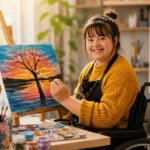
Acrylic painting: One of the most accessible forms of expression. Acrylics are forgiving, vibrant, and immediate. I work with adults and kids in Melbourne who’ve never touched a paintbrush before, and within minutes they’re creating visual representations of their internal chaos. You don’t need skill – you need willingness to let the paint speak for you.
I had a client in Caulfield North who couldn’t describe her anxiety, but she created this painting with jagged, dark red strokes cutting across muted grays. That single piece communicated more than 30 minutes of questioning ever could. The beauty of painting is that it bypasses verbal processing entirely – you’re working directly from emotion to canvas.
Starting a beginner’s painting practice: If you’re new to this, start simple. Get some basic acrylics, a canvas or heavy paper, and a few brushes. Don’t think about “making art” – think about making your feelings visible. Angry? Stab the canvas with harsh strokes. Sad? Let colours blend and drip. Confused? Layer contradictory colours on top of each other.
For adults dealing with mental health challenges, regular painting sessions can be transformative. It’s not about becoming skilled; it’s about developing a visual language for states you can’t verbalize.
Strategy 2: Drawing and Sketching as Daily Emotional Check-Ins
Not everyone connects with painting, and that’s fine. Drawing and sketching offer different pathways to expression.
Sketching as emotional mapping: Keep a sketchbook specifically for emotional expression. Each day, spend 5-10 minutes sketching how you feel. It doesn’t have to be representational. Scribbles, shapes, lines, patterns – whatever emerges. Over time, you’ll notice patterns. “Oh, I always draw tight spirals when I’m anxious” or “Soft, flowing lines mean I’m calm.”
I’ve worked with people through NDIS-funded programs who use daily sketching as their primary emotional regulation tool. One young person with autism creates intricate geometric patterns – the more complex and tight the pattern, the more overwhelmed they’re feeling. Their support workers have learned to “read” these drawings and respond appropriately.
Starting a sketching practice: All you need is a simple sketchbook and pencils. Set a daily reminder on your phone. When it goes off, grab your materials and sketch for just five minutes. Don’t judge, don’t erase, don’t overthink. This is data collection about your internal world, not art creation.
Strategy 3: Structured Creative Classes Can Build Your Emotional Vocabulary
Here’s something I’ve noticed working in my home studio in Caulfield North: people who engage in regular creative practice – whether therapeutic or recreational – often develop better emotional awareness over time.
Art classes for emotional development: When you attend regular sessions focused on creative expression, you start building connections between your internal states and external expression. You learn that certain colours, techniques, or subjects emerge when you’re in particular emotional states.
I run art therapeutic sessions for both adults and children where we focus not on creating “good” art but on using art materials to process emotions. Adults often come in feeling skeptical – “I’m not creative” or “I can’t draw” – but leave with tangible visual representations of feelings they couldn’t name when they arrived.
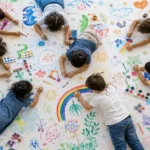
For children: Kids often struggle even more than adults to verbalize emotions. Children’s creative workshops provide a safe, structured environment where they can express big feelings through painting, drawing, collage, and other mediums. A child might not be able to say “I feel abandoned and scared,” but they’ll paint a tiny figure in the corner of a huge, dark canvas – and suddenly everyone understands.
Through my work with children in Melbourne, I’ve seen how regular creative practice builds emotional literacy. A child who attends weekly sessions for several months develops their own visual language. Parents and teachers learn to “read” their artwork as communication.
Strategy 4: Explore Different Creative Mediums
Not everyone connects with painting or drawing. The key is finding your medium.
Collage: Cut images from magazines that resonate with your feeling state. The act of searching, choosing, and arranging can help organize internal chaos without requiring you to create images from scratch.
Sculpting with clay: For people who are more tactile, working three-dimensionally with clay can unlock expression. There’s something powerful about physically shaping your emotions with your hands.
Mixed media: Combine materials – paint, paper, fabric, found objects. Sometimes the combination of textures and methods creates expressions that a single medium can’t capture.
In my work at Artreach Collective, I incorporate diverse materials because everyone’s brain works differently. Some people need the fluidity of paint, others need the control of pencil, and still others need the physicality of clay. There’s no wrong choice – just your choice.
Strategy 5: Use Visual Prompts and Tools
Sometimes you need scaffolding to help expressions emerge. Try these approaches:
Colour association: “If this feeling had a colour, what would it be?” Then paint or draw only with that colour. Notice what happens.
Shape exploration: Some emotions feel sharp and angular, others soft and circular. Draw shapes that match your internal state without worrying about representation.
Feelings wheels with visual elements: Keep a feelings wheel, but add a creative component. When you identify an emotion (even vaguely), create a small sketch or colour swatch that captures it. Over time, you build a personal visual emotion library.
I’ve worked with young people in South Yarra and Brighton who keep emotion journals using both words and visuals. When words fail, they draw. When they can write, they do. The combination creates a fuller picture of their emotional life.
Strategy 6: Body-Based Practices
Your body often knows what’s happening before your mind does. These somatic techniques can help:
Movement before creation: Sometimes you need to move your body first. Dance, shake, stretch for a few minutes, then immediately sit down with art materials and create from that more regulated state.
Breathwork paired with art-making: Try box breathing (inhale for 4, hold for 4, exhale for 4, hold for 4) while painting or drawing. The rhythmic breath can help access deeper emotional states.
I’ll admit my understanding here has limits. While I incorporate body awareness into my work, I’m trained primarily in art therapy and counselling through Swinburne University. What I observe is that people who combine physical regulation with creative expression often have breakthroughs.
Strategy 7: Consider Therapeutic Support
If your loud mind and absent words are significantly impacting your life, therapeutic support can help. As a qualified Mental Health Therapist and member of the Australian Counselling Association, I work with people who struggle with verbal expression using creative therapeutic approaches.
Art therapy vs. art classes: It’s important to understand the difference. Recreational art classes are wonderful for skill-building and enjoyment. Art therapy, however, is a clinical intervention where a trained therapist uses creative processes specifically to address mental health challenges, trauma, or emotional difficulties.
In therapeutic settings, there’s no pressure to verbalize. The art itself becomes communication. A trained art therapist can “read” your creative work and help you process emotions without forcing verbal articulation before you’re ready.
For NDIS participants: If you’re on the NDIS with psychosocial disabilities or mental health vulnerabilities, you have funding options for therapeutic support including art therapy and mental health counselling in Melbourne. Don’t let this challenge go unaddressed when support is available.
Strategy 8: Give Yourself Permission to Process Slowly
Here’s something crucial: not everyone processes emotions in real-time. Some people need hours, days, or even weeks before they can articulate what happened.
If someone asks “What’s wrong?” and you genuinely don’t know, that’s a valid answer. Try saying:
- “I’m feeling something big, but I can’t name it yet. Can I come back to you?”
- “My mind is really loud right now, but I need time to figure out what it’s saying.”
- “I’m overwhelmed, and I don’t have words for it yet.”
This is especially important if you’re neurodivergent. From my work with people on the autism spectrum here in Melbourne, I’ve learned that processing delays are completely normal. Forcing yourself to verbalize before you’re ready often leads to shutdown.
When to Seek Professional Help
If your loud mind and absent words are accompanied by:
- Thoughts of self-harm
- Complete inability to function in daily life
- Physical symptoms that won’t go away
- Isolation that’s lasted weeks or months
If you’re looking for art therapy or mental health counseling support in Melbourne, I offer therapeutic sessions from my home studio in Caulfield North. You can find directions and more information about my practice . For those on the NDIS or seeking creative therapeutic approaches for emotional expression, feel free to reach out. Whether you’re interested in art therapy, painting classes, or mental health counseling, I’m here to help you find the right approach for your needs.
Looking Forward: What Might Change
Here’s what excites me about the future: we’re finally accepting that emotional expression doesn’t have to be verbal. Mental health services are diversifying their approaches beyond traditional talk therapy.
Through my work and years of training – including my Fine Arts degree from Monash University (with studies in Italy exploring Renaissance masters) and my Masters in Counselling specializing in Creative Art Counselling – I’ve seen the therapeutic world shift. What was once “alternative” is becoming mainstream.
But here’s what’s still unclear: will we develop better tools to understand why some brains process emotions verbally and others don’t? Will neuroscience give us clearer answers? I hope so, but I’m honest enough to say I don’t know.
What I do know is this: if your mind is loud but words don’t come, you’re not alone, you’re not failing, and there are pathways forward. They might not be traditional “talk it out” pathways, but they’re just as valid. In 2026, we have more tools, more understanding, and more acceptance of different ways of processing emotions than ever before.
Your loud mind deserves to be heard – even if it needs a paintbrush, sketch pad, or clay to express itself. Find the method that works for you, and know that the journey toward understanding your own inner world is worthwhile, even when it’s not straightforward.
Frequently Asked Questions
Q: Can painting help if I’ve never been artistic?
A: Yes! Therapeutic painting isn’t about skill – it’s about expression. Many adults I work with have never painted before but find it incredibly helpful for processing emotions they can’t verbalize.
Q: What’s the difference between art classes and art therapy?
A: Art classes focus on learning techniques. Art therapy is a clinical mental health intervention where a qualified therapist uses creative processes to address emotional or psychological challenges.
Q: How do I start with creative expression?
A: Start small – get a sketchbook and spend 5 minutes drawing how you feel, or try beginner acrylic painting with basic materials. There’s no right or wrong way to express yourself.
Q: Is this helpful for children who can’t explain their feelings?
A: Absolutely! Children often express emotions naturally through creative activities that they can’t put into words. Children’s art sessions provide safe spaces for feelings to emerge without verbal pressure.