If you have ever picked up a pencil and thought “I am not creative enough for this,” you are not alone. Millions of people feel that way. But here is the truth: sketching is not about being talented. It is about showing up. And when you show up every single week, something remarkable begins to happen not just on the page, but inside your mind, your confidence, and even your mental health.
Weekly sketching sessions are growing in popularity across Australia, and for good reason. Whether you are a complete beginner, a hobbyist, or someone returning to art after years away, the benefits of regular drawing practice go far deeper than most people expect. This article breaks down exactly what you gain, why it works, and how to make the most of it.
Why People Are Turning to Regular Sketching Sessions
Life is busy. Screens are everywhere. Stress is constant. People are searching for something that feels real, tactile, and genuinely rewarding. That is where sketching comes in.
According to a 2021 study published in the journal Empirical Studies of the Arts, people who engage in regular visual art activities report significantly lower levels of anxiety and stress compared to those who do not. Drawing activates a flow state, a psychological condition first described by researcher Mihaly Csikszentmihalyi, where your brain becomes fully absorbed in a task, pushing out worry and mental chatter.
But beyond the science, there is a deeply human reason people keep coming back to sketching groups. It feels good. It connects you to others. And it gives you something you created with your own hands.
The Real Benefits of Attending Weekly Sketching Sessions
1. You Build a Consistent Creative Practice
One of the hardest things about any creative pursuit is consistency. When you attend a weekly session, the schedule is made for you. You do not have to find motivation from scratch every time. The structure of a regular group meeting removes friction and builds habit.
Habit formation research, including work from the University College London, shows it takes an average of 66 days to form a new behaviour. Weekly sketching sessions fast-track that process because you are practising in a social environment, which adds accountability and enjoyment, two of the most powerful drivers of long-term habit change.
Over weeks and months, you will notice your hand begins to move with more confidence. Lines become more deliberate. Your eye-hand coordination sharpens. This kind of progressive skill development is deeply satisfying and gives you a real sense of accomplishment.
2. Your Mental Health and Well-being Improve
This is not a soft benefit. The mental health gains from regular drawing sessions are backed by substantial research.
Art therapy and expressive drawing have been shown to reduce cortisol levels (the stress hormone), improve mood, support emotional regulation, and help people process difficult feelings without needing words. The act of putting pencil to paper is grounding. It pulls you into the present moment in the same way mindfulness practices do.
For people dealing with anxiety, depression, burnout, or just the general overwhelm of modern life, a weekly sketching session offers something rare: a dedicated hour or two where the only goal is to draw. No productivity pressure. No inbox. Just you and the page.
Many people describe their weekly drawing group as “the best part of the week.” That is not a small thing.
3. You Develop Observational Skills That Change How You See the World
Sketching teaches you to truly look at things. When you draw a tree, a face, or a mug on a table, you have to slow down and notice details you would normally walk right past. The curve of a shadow. The texture of bark. The way light falls across a cheekbone.
This kind of trained observation transfers into everyday life. Artists often describe a shift in perception that happens after sustained drawing practice, the world simply becomes more interesting and more vivid. You notice more. You appreciate more. Your visual literacy improves.
This is particularly useful for people who work in design, photography, architecture, fashion, marketing, or any field where visual communication matters. But honestly, it enriches life for everyone.
4. You Find a Creative Community That Actually Supports You
Solitary creativity can be isolating. One of the biggest hidden benefits of attending group sketching sessions is the community you build. You are surrounded by people who share your interests, who cheer for your progress, and who make you feel like your creative work matters.
This sense of belonging is a genuine health benefit. Research from Brigham Young University found that social connection reduces the risk of premature death by 50 per cent, comparable in effect to quitting smoking. A drawing circle might not sound like a health intervention, but the social bonds formed through regular creative gatherings have real, documented effects on wellbeing.
You also learn informally. Watching how someone else approaches a subject, picks a medium, or solves a compositional problem teaches you things no YouTube tutorial can replicate.
5. Your Confidence Grows – Even If You Think You Have No Talent
Here is something almost everyone who attends regular sketching sessions reports: they get better. Not because some magical talent appears, but because practice works. Every session adds to your skill base. Every mistake teaches you something.
More importantly, when you see your own progress over weeks and months, your confidence shifts. You stop saying “I can’t draw” and start saying “I’m still learning.” That is a profound change in self-perception, and it carries over into other areas of life, work, presentations, personal projects, creative writing, cooking, and anything requiring creative risk.
Sketching also encourages a healthy relationship with imperfection. In a supportive group environment, a “bad drawing” is never shameful. It is just part of the process. That mindset is genuinely life-changing for many people.
6. It Sharpens Focus and Cognitive Function
In a distracted world, the ability to concentrate deeply is becoming rare and valuable. Children’s art workshops and sketching activities demand focused attention for sustained periods. Over time, this practice actually strengthens your capacity for concentration the same way physical exercise strengthens muscles.
Some neuroscience research suggests that visual art activities stimulate neural pathways associated with spatial reasoning, memory, and problem-solving. Children who engage in regular drawing activities show improvements in literacy and numeracy, and adults who sketch regularly report sharper thinking and better ability to plan and visualise outcomes.
Whether you are a student, a professional, or someone in retirement looking to keep your mind active, a weekly drawing session is one of the most enjoyable ways to do it.
7. You Unlock a New Form of Self-Expression
Sometimes words are not enough. Emotions, ideas, and experiences that are hard to articulate verbally can often find form on paper. Sketching gives you a language that works differently from speech or writing, one that is immediate, personal, and deeply honest.
Many people come to drawing later in life and discover it becomes their primary way of processing and expressing who they are. Journals filled with quick sketches, observational drawings from daily life, portraits of people they love, these become meaningful records of a life lived with attention and intention.
What to Expect When You First Attend
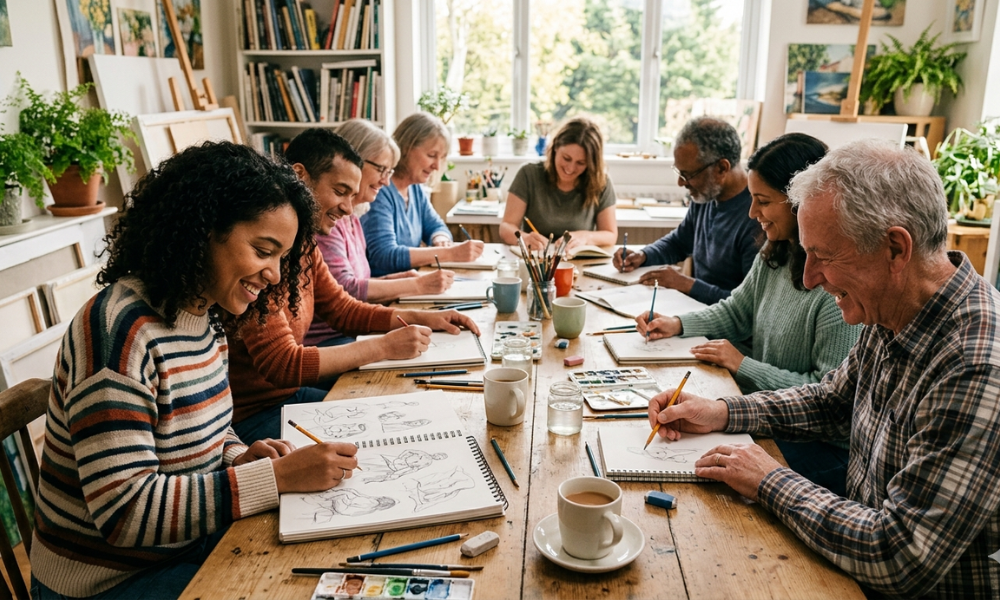
If you have never attended a group sketching session before, the first visit can feel a little daunting. Here is what typically happens: you arrive, you are welcomed, you are given a prompt or subject, and you draw. There is no grading, no comparison, no critique unless you ask for it.
Most sessions are welcoming to all skill levels. You will likely find a mix of beginners, intermediate drawers, and more experienced artists sitting side by side. The atmosphere tends to be relaxed, conversational, and genuinely warm.
Bring a sketchbook, a pencil, and an open mind. That is genuinely all you need.
Frequently Asked Questions
Q: Do I need to know how to draw before attending?
A: Not at all. Weekly sketching sessions are designed for all skill levels, including complete beginners. The goal is practice and participation, not perfection.
Q: How quickly will I see improvement?
A: Most people notice measurable improvement within four to six weeks of regular attendance. Consistency matters far more than natural ability.
Q: What supplies do I need?
A: A basic sketchbook and pencils are usually enough to start. Some sessions may suggest specific materials, but most welcome any drawing tools you are comfortable with.
Q: Is sketching good for mental health?
A: Yes. Drawing has been consistently linked to reduced anxiety, lower stress levels, improved mood, and better emotional regulation. It is used therapeutically worldwide.
Q: Can sketching help with focus and productivity?
A: Yes. Regular drawing practice strengthens sustained attention and has been linked to improvements in concentration, spatial reasoning, and creative problem-solving.
A Simple Invitation Worth Taking Up
If you are in Melbourne and you have been thinking about finding a creative outlet, something that fits into your weekly routine without pressure or expectation, attending a local sketching session might be exactly what you are looking for.
Artreach Collective runs regular community sketching sessions across Melbourne, including in Brunswick, Fitzroy, and the inner north. The sessions are welcoming, relaxed, and open to anyone regardless of experience level. In addition to these community sessions, Artreach Collective also offers NDIS art classes in Melbourne, providing tailored support for participants who want to explore their creativity in a structured and inclusive environment.
It is worth trying at least once. Most people who do end up coming back every week wonder why they waited so long.