Introduction: Your Mind is Busier Than Ever, – and That’s a Problem
Most people today struggle to sit still with one task for more than a few minutes. Between constant notifications, packed schedules, and the pressure to multitask, genuine concentration has become surprisingly rare. If you find yourself jumping between tabs, losing your train of thought, or feeling creatively blocked, you’re not alone.
But here’s something worth knowing: one of the most effective tools for rebuilding your focus, developing patience, and unlocking creative thinking isn’t a productivity app or a mindfulness programme. It’s drawing.
Learning to draw might seem like a hobby reserved for “artistic” people. The truth is, it’s a practical cognitive skill that trains your brain in ways very few other activities can match. This article explores exactly how picking up a pencil can reshape the way you think, concentrate, and create, even if you’ve never drawn a single thing in your life.
What Happens in Your Brain When You Draw?
Before diving into the benefits, it helps to understand what drawing actually does to your brain on a functional level.
When you draw, you engage both the left and right hemispheres simultaneously. The left hemisphere handles logical sequencing, measuring proportions, following steps, and planning. The right hemisphere manages spatial awareness, pattern recognition, and visual interpretation. This dual engagement is rare. Most daily tasks rely heavily on one side or the other.
Studies in cognitive neuroscience suggest that regular drawing activates areas of the brain linked to memory consolidation, sensory processing, and problem-solving. The act of observing something closely and then translating it onto paper forces your brain to slow down, process deeply, and engage with detail, all of which are core components of focused thinking.
This is one reason many people are now exploring structured creative art classes as a way to build both artistic skills and mental focus. Guided practice in such settings often helps individuals strengthen observation skills while gradually developing confidence in their creative abilities.
Drawing also stimulates neuroplasticity, the brain’s ability to form new neural connections. The more you practise, the more efficiently your brain learns to shift between analytical thinking and imaginative thinking, which is exactly the mental flexibility that supports creative problem-solving.
How Drawing Builds Genuine Focus
Training Your Attention Span, One Line at a Time
Focus isn’t just about willpower. It’s a skill, and like any skill, it can be trained. Drawing is one of the most direct ways to do that.
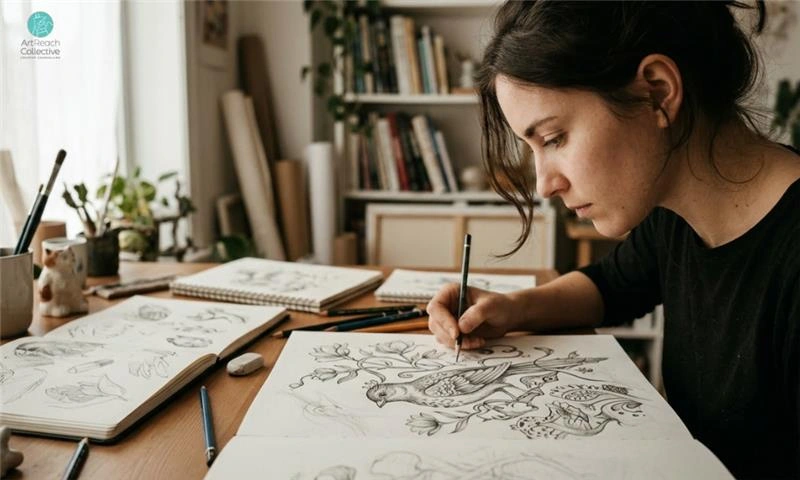
When you sit down to sketch, whether it’s a still life, a landscape, or a simple object from your desk, you’re required to observe and respond deliberately. There’s no shortcut. You have to look, process, and replicate. That sustained attention, held over even 10 to 20 minutes, builds what psychologists call “attentional control.”
Over time, this practice transfers. People who draw regularly often report that they find it easier to stay present during conversations, absorb information more deeply when reading, and maintain concentration on tasks at work or study.
The Role of Flow State
Drawing is one of the most reliable pathways into a “flow state,” a deeply absorbed mental condition where time disappears and performance peaks. When you’re in flow, your brain operates at a uniquely productive frequency: calm but alert, challenged but not overwhelmed.
Regular access to flow through drawing can reset your baseline focus levels, making it easier to access deep concentration in other areas of your life.
Drawing as a Lesson in Patience
Learning to Sit with the Process
One of the hardest things about drawing is that it can’t be rushed. A line drawn in haste rarely looks right. Shading requires layering. Proportions need checking and rechecking. The craft simply demands patience, and it teaches it by design.
For many beginners, this is uncomfortable at first. We’re not used to slowing down. But drawing rewires that impatience gradually. As you build skill and begin to see results from careful, deliberate effort, your tolerance for process grows.
This shift in tolerance is genuinely transferable. People who practise drawing consistently tend to develop better emotional regulation, reduced frustration when things don’t go to plan, and a greater ability to stay steady when outcomes are uncertain.
Embracing Mistakes as Part of the Method
Drawing also teaches you how to fail productively. You’ll make marks that don’t work. You’ll misjudge angles. You’ll start over. And each time you do, you’re practising resilience, the ability to continue without catastrophising.
This is perhaps one of drawing’s most underrated cognitive benefits: it normalises imperfection and builds a healthier relationship with effort over outcome.
How Drawing Unlocks Creative Thinking
Seeing Differently
One of the first things drawing teaches you is how to actually see. Not just glance but observe. Artists learn to see light, shadow, negative space, and proportion in ways that most people never do. This shift in visual perception doesn’t stay contained to art. It bleeds into everyday life.
When you train your eyes to notice nuance and complexity, your brain begins to approach problems the same way. You start seeing things from multiple angles, noticing what others miss, and finding unexpected connections, all hallmarks of strong creative thinking.
Building Visual and Spatial Intelligence
Drawing strengthens visual-spatial intelligence, one of Howard Gardner’s multiple intelligences. This type of thinking is critical in fields like architecture, design, engineering, strategy, and even writing. The ability to mentally rotate objects, understand relationships between shapes, and visualise outcomes is directly cultivated through regular drawing practice.
Idea Generation and Conceptual Thinking
Sketching is also used as a professional creative tool across industries. Designers sketch concepts. Engineers draw prototypes. Writers create visual mind maps. When you learn to draw, you’re also learning to externalise abstract ideas to pull something from inside your head and give it form.
This process strengthens conceptual thinking and trains your brain to move fluidly between abstract and concrete modes of thought, which is central to innovation and problem-solving.
Who Can Benefit from Learning to Draw?
The short answer: almost anyone. But certain groups tend to see particularly strong results:
Children and young learners benefit from drawing as a tool for developing hand-eye coordination, narrative thinking, and emotional expression.
Students find that drawing notes, diagrams, and concepts improves memory retention significantly compared to written notes alone, a well-documented finding in educational psychology.
Working professionals, particularly those in high-pressure, fast-paced roles, often use drawing as a mental reset that reduces cognitive fatigue and restores creative energy.
Adults managing anxiety or stress find drawing deeply grounding. The sensory focus required pencil on paper, mark-making, and observation anchors the nervous system in a way similar to mindfulness meditation.
Older adults can use drawing as a form of cognitive exercise, supporting mental acuity and fine motor skills well into later life.
Getting Started: You Don’t Need Talent
The biggest misconception about drawing is that you need natural talent to begin. You don’t. Drawing is a learned skill, not an inherited gift.
Start small. Spend 10 to 15 minutes a day drawing simple objects, a cup, a leaf, a shoe. Don’t aim for perfection. Aim for observation. The goal in the early stages is not a beautiful result; it’s building the habit of careful looking and deliberate mark-making.
There are excellent beginner resources available, structured classes, community workshops, and online tutorials that guide you through the fundamentals in a logical, progressive sequence. In-person instruction, in particular, offers the added benefit of feedback, community, and accountability.
FAQ: Quick Answers to Common Questions
Q: Can drawing really improve focus in adults?
A: Yes. Drawing requires sustained attention and deliberate observation, both of which strengthen attentional control over time. Regular practice has been linked to improved concentration across tasks.
Q: Do I need any prior experience to start drawing?
A: No prior experience is needed. Drawing is a skill that develops with consistent practice, regardless of starting point.
Q: How long does it take to see cognitive benefits from drawing?
A: Many people notice improved calm and focus after just a few weeks of regular practice. Deeper cognitive benefits like enhanced creative thinking and patience tend to build over months of consistent engagement.
Q: Is drawing better than other creative hobbies for focus?
A: Drawing is particularly effective because it combines visual processing, motor control, and observation simultaneously. However, any sustained creative practice can offer focus-building benefits.
Q: Can drawing help children with attention difficulties?
A: Drawing can be a supportive tool for children who struggle with sustained attention, as it provides structured, engaging, and rewarding practice in focused observation.
A Final Thought: Creativity is a Skill Worth Investing In
In a world that constantly fragments your attention, learning to draw is an act of reclaiming it. It’s a practice that asks you to slow down, look closely, and stay with something long enough to understand it and in doing so, it reshapes the way your mind works.
Whether you’re looking to sharpen your focus, develop more patience, or think more creatively in your work and everyday life, drawing offers a surprisingly powerful path forward.
If you’re based in Australia and are curious about where to begin, Artreach Collective offers welcoming, structured drawing programmes and art therapy in Melbourne and other locations across in Australia, a great place to start your creative journey in a supportive environment.
Pick up a pencil. You might be surprised by what it teaches you.