I’ve been working at the intersection of art and mental health for over 15 years now, and honestly, I never expected to see art therapy move from the margins to the mainstream quite this quickly. But here 2026 is coming, and suddenly everyone from corporate executives to teenagers scrolling TikTok seems to be talking about using creativity as a pathway to healing. As the founder of Artreach Collective, a boutique for art therapy practice in Melbourne, Australia, I’ve had a front row seat to this transformation, and I want to share what I’m seeing both the exciting possibilities and the questions that keep me up at night.
Why Art Therapy Is Having Its Moment Right Now
Let me be upfront: I might be slightly biased given that I’ve dedicated my career to this field. But even accounting for my enthusiasm, the data tells a compelling story. According to recent discussions in mental health forums and professional circles, there’s been a noticeable surge in people seeking alternative therapeutic approaches that don’t rely solely on traditional talk therapy.
The reason? I think we’re collectively burned out on words. We’ve spent years trying to verbalize our trauma, explain our anxiety, and articulate our depression. Sometimes that works beautifully. Other times, it feels like trying to describe the ocean to someone who’s never seen water. Art therapy offers a different language entirely, one that doesn’t require you to have the “right” words or even any words at all.
From my practice in Caulfield North, I’ve watched clients who’ve struggled with traditional counselling for years suddenly find breakthroughs when handed a paintbrush or a lump of clay. There’s something about bypassing the logical, verbal brain and going straight to the hands that unlocks doors we didn’t even know were closed.
The Neuroscience Backing (That I’m Still Wrapping My Head Around)
Now, I’ll admit that I’m an artist and therapist first, neuroscientist distant last. But even I can’t ignore the fascinating research emerging about how creative expression literally rewires our brains. Studies have shown that engaging in art activates multiple brain regions simultaneously; the motor cortex, the visual processing areas, and the emotional centers all light up like a Christmas tree.
What’s particularly interesting for my work with people experiencing autism, disabilities, and mental health challenges is how art therapy seems to create new neural pathways. It’s like we’re building side roads when the main highway is congested. One of my colleagues, a clinical counsellor who’s been practicing even longer than I have, likes to say that art therapy is “sneaky healing”. Your conscious mind is focused on mixing the right shade of blue, while your subconscious is processing that argument with your mother from fifteen years ago.
The Art Therapy Association has published compelling evidence about art therapy’s effectiveness for PTSD, anxiety, and depression. While I can’t claim to understand all the technical jargon in those research papers (give me a palette knife over a peer reviewed journal any day), the practical implications are clear: making art changes not just how we feel, but how our brains function.
What’s Actually Different in 2026
So what’s changed between when I started this work and now? Three big shifts stand out.
Digital Integration Without Losing the Tactile
First, there’s been this interesting dance between technology and traditional art making. When I started my practice, it was all about paint, clay, collage and physical materials you could touch and smell. Now, about a quarter of my sessions incorporate digital tools like tablets for drawing or apps that let clients manipulate images. But here’s what’s fascinating: we’re not abandoning the physical. Instead, we’re blending them.
I had a young client recently who creates digital sketches during the week on her phone (because that’s where she lives, digitally speaking), then we print them and physically tear, rearrange, and collage them in our sessions. She told me that the act of physically ripping up her anxious thoughts felt more cathartic than any delete button ever could. The digital is a starting point, but the transformation happens through touch.
Accessibility Is Finally Getting Serious Attention
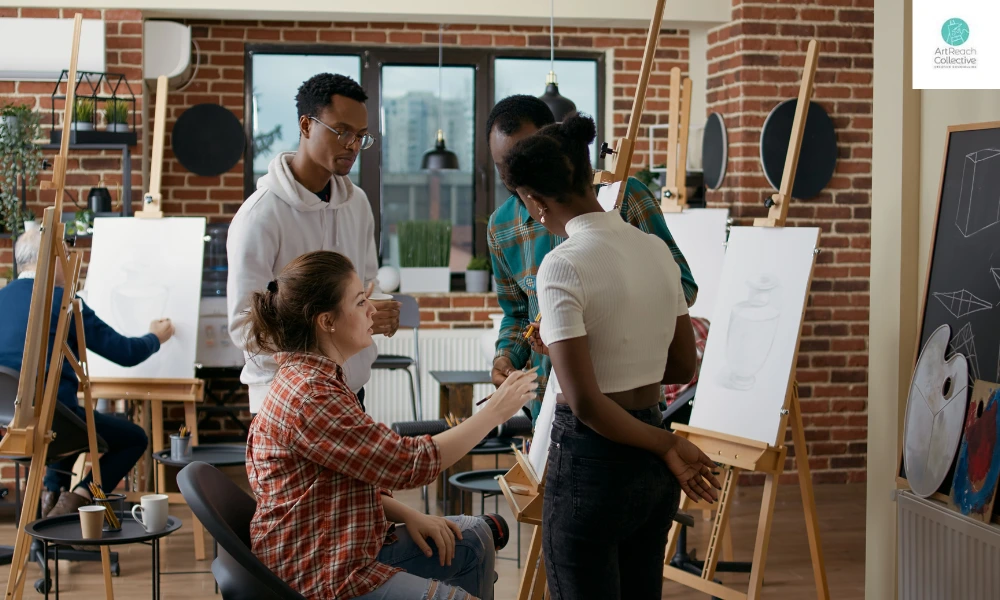
Second, there’s been a genuine push to make art therapy more accessible, and not just in the “we have a wheelchair ramp” sense. I’m talking about financial accessibility, cultural accessibility, and neurodivergent friendly approaches. At Artreach Collective, I’ve specifically designed my home studio space to be sensory friendly because over 20 years of working as an artist and 15 years in disability and mental health have taught me that environment matters enormously.
Online discussions in mental health communities have highlighted how traditional therapy spaces with their neutral walls and uncomfortable couches can actually increase anxiety for some people. My studio has natural light, materials at different heights, and options for standing or sitting. It’s not fancy, but it acknowledges that healing doesn’t happen in a one size fits all box.
Self Expression Is Being Recognized as Essential, Not Extra
Third, and perhaps most importantly, we’re finally seeing self expression recognized as a fundamental human need, not some luxury for people with spare time. The World Health Organization has increasingly emphasized creative activities as part of mental health treatment, and I’m seeing this filter down into mainstream consciousness.
I’ve noticed people using phrases like “creative outlet” and “expressive arts” in everyday conversation, not just in therapy circles. My neighbor, who works in accounting and definitely doesn’t consider himself an “artist,” mentioned he’s been doing adult coloring books to manage work stress. Five years ago, he would have been embarrassed to admit that. Now? It’s just smart self care.
The Challenges Nobody’s Talking About (But Should Be)
Okay, real talk time. This boom in art therapy interest isn’t all sunshine and properly mixed paint colors. There are some concerning trends I’m watching.
The Instagram Reification Problem
With art therapy becoming trendy, I’m seeing a lot of “art therapy” content online that’s really just… arts and crafts. Don’t get me wrong, making things is wonderful for your mental health. But calling every Pinterest project “art therapy” dilutes what clinical art therapy actually involves.
As a qualified member of the Australian Counselling Association (Level 2), I’ve completed specific training that combines psychological theory, counselling skills, and creative arts understanding. When someone without this background sells “art therapy sessions,” it can lead to people having negative experiences or, worse, retraumatization if difficult emotions come up without proper therapeutic support.
I’m not trying to gatekeeper creativity; anyone can and should make art for personal wellbeing. But professional art therapy involves holding space for people in their most vulnerable moments, and that requires training and accountability.
The Measurement Trap
There’s also increasing pressure to “prove” art therapy works through quantifiable metrics. Healthcare systems and insurance companies want numbers: percentage improvements, reduction in symptoms, session counts. And look, I get it. Resources are limited, and we need to show effectiveness.
But how do you measure the moment when someone with severe anxiety creates their first painting in five years? How do you quantify the shift that happens when a person with autism finds a way to express their sensory experience through color? Some of the most profound changes I’ve witnessed in my practice happen in spaces that spreadsheets simply can’t capture.
We’re learning to navigate this tension, but it remains a challenge. Evidence based practice is crucial, but so is honoring the messy, non linear reality of human healing.
Real Stories From the Studio
Let me share a couple of examples that illustrate what I’m seeing (with identifying details changed for privacy, obviously).
I worked with a woman in her fifties who’d been through traditional talk therapy for depression for years with minimal progress. In our first session, I asked her to simply put color on paper, no image, no goal, just see what happened. She cried through the entire session, not from sadness but from relief. “I didn’t realize how exhausting it’s been trying to explain myself,” she told me. Over the following months, her abstract color work evolved into a visual language for emotions she’d never been able to articulate verbally.
Another client, a teenager with high functioning autism, struggled with emotional regulation and social situations. Talking about feelings felt impossible for him; the words never quite fit what he was experiencing. But through creating graphic novel style illustrations of his daily life, he began identifying patterns in what triggered his overwhelm. His parents said it was like suddenly having a decoder ring for understanding their son.
These aren’t unique to my practice. Therapists across Melbourne and throughout Australia are reporting similar stories. The Australian Counselling Association forums are full of practitioners sharing these moments of breakthrough.
Where I Think We’re Heading (And What Still Puzzles Me)
Looking forward, I’m cautiously optimistic about art therapy’s trajectory. I think we’ll see more integration with traditional mental health services rather than being sidelined as an “alternative.” Medical centers are already starting to include creative therapists on their teams, recognizing that different brains need different approaches.
I’m also hopeful about preventative applications. Rather than waiting until someone is in crisis, what if art therapy became a regular part of maintaining mental health? Like going to the gym for your emotional wellness. We’re seeing glimmers of this in schools and workplaces, though we’ve got a long way to go.
But I’ll be honest there’s plenty I don’t know. Will AI generated art have a place in art therapy, or does the human creation process matter more than the outcome? As virtual reality becomes more accessible, will remote art therapy sessions through VR feel as effective as in person work? How do we balance the need for professionalization with keeping art therapy accessible and not overly medicalized?
I’m also curious about cultural applications. My practice is based in Melbourne, which is beautifully multicultural, but art therapy has largely developed through Western psychological frameworks. How do we honor different cultural relationships with art, healing, and mental health? This is work that’s just beginning.
Final Thoughts From the Studio Floor
After 15 years in disability and mental health work, and over 20 years as an artist, I’ve learned that transformation rarely looks how we expect it to. Sometimes personal growth happens in a dramatic revelation. More often, it’s in the quiet accumulation of small moments, a color choice, a mark on paper, the way someone’s shoulders relax when they stop trying to explain and just create.
Art therapy in 2026 is at an interesting crossroads. It’s gaining recognition and backing, which is fantastic. But with that comes the risk of losing what makes it special: the messy, unscripted, deeply personal process of expressing what words can’t touch.
My hope is that we can ride this wave of interest while staying grounded in what actually helps people. Not every trending topic deserves to trend, but this one? This one might actually change how we think about healing, self expression, and what it means to live our best possible lives.
From my little studio in Caulfield North, I’m watching it unfold, one brushstroke at a time.
Frequently Asked Questions
Q: What exactly is art therapy?
A: Art therapy is a form of psychotherapy that uses creative expression for healing. Unlike art classes focused on technique, art therapy explores your emotions through the creative process. A qualified art therapist combines counselling training with creative arts expertise.
Q: Do I need to be good at art?
A: Absolutely not! Art therapy isn’t about creating beautiful artwork—it’s about expressing yourself authentically. The process matters far more than the product.
Q: How do I know if it’s right for me?
A: Art therapy is particularly helpful if you find it difficult to express emotions verbally, if traditional talk therapy hasn’t worked, or if you’re dealing with trauma, anxiety, autism, or other challenges where words feel limiting.
Q: What happens in a session?
A:We start with a brief check in, then you create art with materials that feel right for you. I support you throughout, helping you explore what emerges. We end by reflecting on the process and discoveries.
Q: Is it covered by insurance in Australia?
A: Some private health insurance covers sessions with registered therapists. You may be eligible for rebates through the Better Access Scheme with a mental health plan from your GP. Check with your provider for specific details.