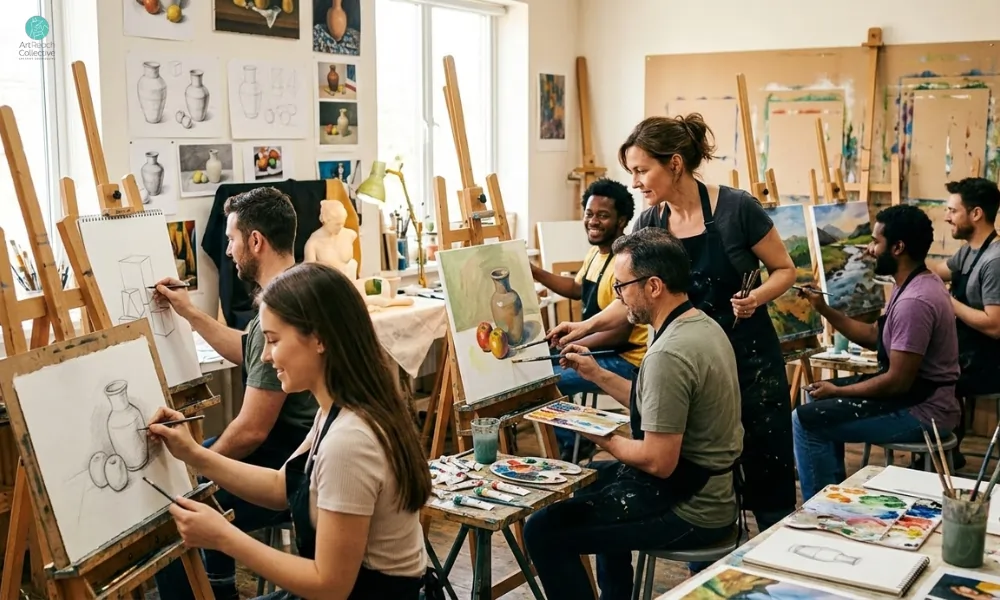
So you’ve decided you want to learn how to paint or draw, but where on earth do you start?
If you’ve ever stared at a blank canvas feeling completely overwhelmed, you’re not alone. Most beginners share the same fears: “I have no natural talent,” “I don’t know what tools to buy,” “I’ll embarrass myself in a class.” These are completely normal feelings, and the good news is that structured art classes are specifically designed to dissolve every single one of them.
Whether you’re drawn to watercolour landscapes, charcoal portraits, or bold acrylic abstracts, a well-guided beginner art class gives you the foundation, the confidence, and the creative vocabulary to grow. This article breaks down exactly how that process works step by step.
Why Total Beginners Struggle to Learn Art on Their Own
Before exploring what art classes offer, it helps to understand why self-teaching often stalls.
Many people attempt to learn painting and drawing through YouTube tutorials or social media platforms like Instagram or facebook etc. While these can be inspiring, they lack personalised feedback, the single most important ingredient in early skill development. Without someone to identify why your proportions look off or why your colours are muddy, you repeat the same mistakes and eventually give up.
Common beginner pain points include:
- Not knowing which art supplies for beginners to purchase
- Feeling uncertain about basic drawing techniques like line weight and shading
- Struggling with colour mixing fundamentals and ending up with flat or dull results
- Having no structured creative learning pathway to follow
- Lacking a supportive environment that normalises making mistakes
Structured art instruction solves all of these problems by providing a guided, scaffolded learning experience from day one.
What Happens in a Beginner Art Class?
The First Session: Orientation and Observation
A quality beginner art class doesn’t hand you a brush and say, “go.” The first session is typically centred around visual observation skills training your eye before your hand.
Instructors introduce foundational concepts such as:
- Line and shape recognition — seeing the world in simplified geometric forms
- Contour drawing exercises — following the edges of objects without lifting your pencil
- Light source identification — understanding where shadows fall and why
This approach is rooted in evidence-based art education. Research consistently shows that teaching beginners to see before they draw dramatically accelerates skill acquisition. It rewires the brain to process visual information more accurately, which directly improves drawing quality.
Building a Visual Language
Art has its own language, and beginner classes act as an immersive language school. Students are introduced to the elements of art line, shape, form, value, texture, space, and colour and the principles of design: balance, contrast, movement, rhythm, and proportion.
These aren’t abstract concepts. Instructors demonstrate them through live examples, student exercises, and guided critique. Over time, these terms become instinctive tools that students use both in class and when working independently.
How Instructors Scaffold Skill Development
Step-by-Step Drawing Instruction
Once foundational observation skills are established, classes progress to structured drawing practice. This is where students begin working through deliberately sequenced exercises:
Stage 1 — Gesture Drawing Short, timed sketches (usually 30 seconds to 2 minutes) that capture movement and energy rather than detail. This loosens the hand and builds confidence in making marks without overthinking.
Stage 2 — Form and Volume Students learn to draw three-dimensional objects using shading techniques such as hatching, cross-hatching, and blending. Understanding how light wraps around a sphere or cylinder is a pivotal moment for most beginners.
Stage 3 — Proportion and Perspective. This is where many self-taught learners struggle most. In-class instruction breaks perspective down into digestible rules, one-point and two-point perspective, horizon lines, and vanishing points using clear visual demonstrations.
Stage 4 — Composition Students are taught the rule of thirds, negative space, and how to arrange subjects within a frame to create visual interest. Strong composition is what separates a pleasing artwork from one that feels unresolved.
Introduction to Painting Techniques
Once drawing fundamentals are solid, many beginner courses introduce painting. The transition is carefully managed by experienced instructors who know that jumping straight into paint can feel chaotic without proper preparation.
Beginner painting classes typically cover:
- Colour theory for artists — the colour wheel, warm and cool colours, complementary contrast, and colour harmony
- Brush control exercises — varying pressure, direction, and stroke length to achieve different textures and effects
- Underpainting and layering — building up a painting gradually rather than trying to achieve a finished look in one sitting
- Acrylic painting techniques for beginners are often chosen for their fast drying time and forgiving nature
- Watercolour washes and wet-on-wet techniques for those interested in a more fluid, translucent medium
Personalised Feedback and Guided Critique
One of the most valuable aspects of structured art classes is constructive critique. Instructors observe each student’s work throughout the session, offering real-time feedback that is both specific and encouraging.
Group critiques, where students discuss each other’s work in a supportive setting, also develop critical thinking in art, teaching students to articulate what is working in a piece and what could be refined. This builds artistic confidence far more effectively than practising in isolation.
The Role of Materials and Medium Selection
A question beginners often ask is: “Should I start with pencil, charcoal, watercolour, or acrylic?”
The answer depends on your goals, but most beginner art classes begin with graphite pencil drawing because it is the most controllable medium and the most forgiving for learning fundamentals. From there, students typically progress based on their interests.
Good art classes guide:
- Choosing beginner-friendly art supplies without overspending
- Understanding the difference between student-grade and artist-grade materials
- How paper weight and texture affect different media
- Basic brush care and tool maintenance
This prevents the common experience of spending a fortune on supplies that don’t match your current skill level.
Overcoming Creative Blocks and Building Consistency
Learning to draw and paint is not a linear journey. There are plateaus, frustrating sessions, and days where nothing seems to work. Experienced instructors recognise this as a normal and necessary part of creative skill development.
In-class strategies for overcoming creative resistance include:
- Warm-up exercises at the start of each session to ease into creative thinking
- Structured practice prompts that remove decision fatigue
- Goal-setting within each class so students leave with a sense of accomplishment
- A growth mindset approach to mistakes – reframing errors as learning data rather than failures
The social aspect of a group class also plays a significant role. Being surrounded by fellow beginners normalises imperfection and creates a sense of shared progress that solo practice simply cannot replicate.
When Should You Seek Guided Instruction?
While free resources have their place, there are clear signs that structured art instruction will deliver far better results for you:
- You’ve been trying to learn independently for months without noticeable improvement
- You consistently feel frustrated and don’t know why your work isn’t improving
- You want to develop a specific style or work towards a creative goal
- You’re preparing work for display, gifting, or personal milestones
- You simply want the motivation and accountability that come with regular classes
In-person classes in particular offer something digital tutorials never can: real-time, medium-specific guidance from a human who can see exactly what your hand is doing and respond to it in the moment.
Frequently Asked Questions
Q: Do I need any prior experience to join a beginner art class?
A: No. Beginner art classes are designed specifically for people with no prior drawing or painting experience. Instructors start from the very basics and build your skills progressively.
Q: What art supplies do I need for my first class?
A: Most beginner classes provide a supply list or materials kit. Typically, you’ll need a sketchpad, a few graphite pencils (HB, 2B, 4B), an eraser, and a blending stump to start. Painting classes may include a starter brush set and a basic palette of colours.
Q: How long does it take to see improvement?
A: Most students notice meaningful improvement within four to six weeks of consistent attendance. The key factors are regular practice between classes and a willingness to apply instructor feedback.
Q: Is it better to learn drawing before painting?
A: Many art educators recommend learning foundational drawing skills first, as understanding form, value, and proportion significantly improves your painting. However, some painting classes are designed for absolute beginners and teach these principles within the painting context.
Q: Can adults with no artistic background learn to draw?
A: Absolutely. The idea that artistic ability is purely innate has been debunked by decades of educational research. Drawing and painting are learnable skills, and adult beginners often progress quickly because of their focus, patience, and motivation.
Start Your Creative Journey With Confidence
Learning to paint and draw is one of the most rewarding creative pursuits you can undertake. It sharpens observation, builds patience, cultivates mindfulness, and ultimately gives you a means of personal expression that is entirely your own.
The path from complete beginner to confident artist isn’t mysterious; it’s structured, teachable, and achievable with the right guidance.
If you’re based in Melbourne and looking for a welcoming, well-structured environment to begin your creative journey, Artreach Collective offers beginner-friendly adult painting and drawing classes designed to guide you through every foundational step with skill and care.
The canvas is waiting. All you need to do is show up.