There is something quietly remarkable happening in wellness circles, therapy rooms, and community spaces around the world. People are picking up paintbrushes, writing in journals, dancing in their living rooms, and finding that in doing so, something inside them begins to shift. The growing recognition that creative expression plays a meaningful role in emotional health is not simply a trend it reflects a deeper truth that humans have always known but science is now beginning to confirm.
Whether you are navigating anxiety, processing grief, or simply feeling disconnected from yourself, engaging in a creative practice may offer something that a conventional approach cannot always reach: a direct line to your inner world, without the pressure of words or explanations.
The Science Behind Art and Emotional Healing
Researchers studying the relationship between artistic activity and psychological health have consistently found that making something activates neural pathways associated with reward, focus, and self-regulation. This neurological foundation is one of the reasons art therapy has become an increasingly respected approach within mental health care. When a person draws, writes, sculpts, or plays music, the brain’s default mode network, the region responsible for self-referential thought, becomes engaged in a purposeful way rather than ruminating or cycling through distress.
This is significant. One of the hallmarks of conditions like depression and post-traumatic stress is the tendency of the mind to loop through painful memories and negative self-concepts. Creative engagement interrupts this pattern by redirecting cognitive resources toward the present moment, which is why art-based approaches are increasingly incorporated into clinical mental health settings.
A frequently cited mechanism is flow state, a concept developed by a psychologist that describes the experience of being fully absorbed in a challenging yet manageable task. Flow reduces cortisol levels, enhances mood, and fosters a felt sense of competence and agency. Creative activities are among the most reliable pathways into this state.
Beyond Art Therapy: Everyday Creative Practices That Support Mental Health
It is worth distinguishing between formal art therapy (a clinically guided process facilitated by a trained professional) and the broader category of expressive practices that anyone can incorporate into daily life. Both are valuable, but the latter is accessible to everyone regardless of skill, budget, or diagnosis.
Some of the most well-evidenced everyday practices include:
Expressive writing and journaling. Writing about emotionally significant experiences, particularly in a reflective, narrative style, has been shown to improve immune function, reduce intrusive thoughts, and support emotional processing. Researchers have demonstrated that even short, consistent writing sessions can meaningfully reduce psychological distress over time.
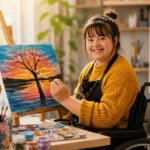
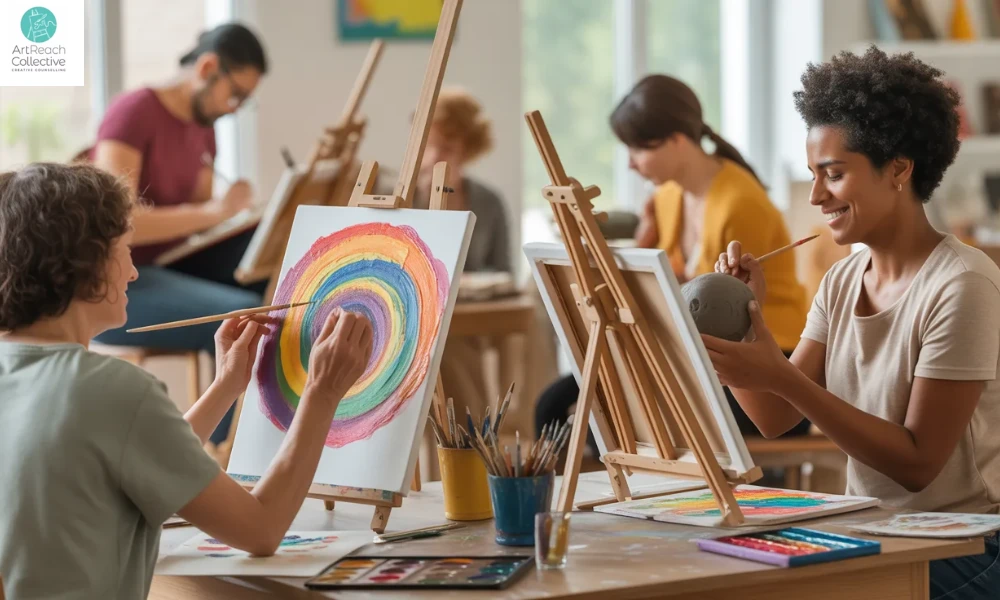
Visual art-making. Drawing, painting, or collage-making allows people to externalise internal states that may be difficult to articulate verbally. This is particularly relevant for trauma survivors, individuals with alexithymia (difficulty identifying emotions), or people navigating loss.
Movement and dance. The body holds emotional experience in physical form, and somatic practices like expressive movement allow for processing that bypasses purely cognitive channels. Dance movement therapy is increasingly recognised within psychotherapy as an effective modality for anxiety, depression, and body image concerns.
Music and sound. Creating or engaging with music activates the limbic system in ways that few other activities can replicate. Drumming, humming, singing, or even just intentional listening can shift autonomic nervous system states from activation to regulation.
Craft and making. Activities like knitting, pottery, woodworking, and textile work offer a grounding, repetitive quality that functions similarly to mindfulness meditation. The tactile engagement keeps attention tethered to the present moment.
Why “I’m Not Creative” Is a Myth Worth Challenging
One of the most persistent barriers to using creative practice for wellbeing is the belief that one must have natural artistic talent to benefit from it. This misunderstands the purpose entirely.
Therapeutic creativity is not about producing something beautiful, impressive, or even coherent. It is about process, not product. The act of making, with all its messiness, frustration, and occasional joy, is where the healing occurs. A scribbled page in a sketchbook, a stumbling dance in a kitchen, a poem that no one else will ever read: these hold as much potential for growth as the most technically polished work.
Cultural narratives around art and identity have led many people to disengage from creative practice by early adulthood. Reconnecting requires permission to be a beginner, to be bad at something, to make without judgment. This is, in itself, a profound act of self-compassion.
Creative Expression in Group Settings: Connection as Medicine
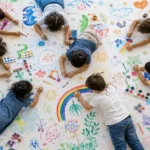
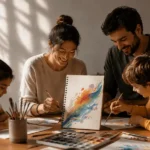
While solo practice carries real benefits, there is something uniquely powerful about creating alongside others. Shared creativity fosters social connection, itself one of the strongest protective factors for mental health while simultaneously reducing the performance anxiety that can arise when making feels like a solitary, high-stakes act.
Group art programs, community music projects, collaborative murals, and writing circles all create what social researchers call “collective effervescence,” the sense of being part of something larger than oneself, accompanied by positive emotional arousal. This experience is genuinely protective against loneliness and isolation, which are increasingly recognised as contributors to poor mental health outcomes at a population level.
Community organisations that bring people together around creative practice are filling a meaningful gap, offering something that sits between formal therapy and social recreation, with profound benefits in both directions.
Who Can Benefit — and When to Seek Additional Support
Creative practices for wellbeing are broadly accessible and carry very low risk. They can be particularly beneficial for people experiencing:
- Mild to moderate anxiety or low mood
- Grief and bereavement
- Life transitions or identity shifts
- Chronic stress and occupational burnout
- Social isolation or loneliness
- Difficulties with emotional articulation
That said, creative practice is best understood as a complement to professional mental health support, not a replacement for it. If you or someone you know is experiencing significant psychological distress, please consult a registered mental health professional alongside any expressive activities you explore.
Integrating Creative Expression Into Your Wellbeing Routine
Starting does not require expensive materials, dedicated studio time, or any prior experience. In fact, many mental health counseling sessions now incorporate simple creative exercises precisely because they are accessible, low-pressure, and effective. A few practical suggestions:
Begin with five minutes. Set a timer and write, draw, or move without an agenda. The brevity removes pressure and makes consistency more achievable.
Separate creating from judging. If the critical voice arises, and it will acknowledge it and return to the task. The practice of continuing despite discomfort is itself therapeutic.
Seek community. Whether in person or online, sharing creative practice with others amplifies its benefits and sustains motivation over time.
Vary your medium. If writing feels stuck, try something visual. If drawing feels exposing, try movement. Different modalities unlock different things.
A Final Word: Making Space for What Cannot Be Said
There are dimensions of human experience that language alone cannot hold. Grief that cannot be named, joy that spills past words, fear that lives in the body before it reaches the mind, these are the territories where creative expression does some of its most meaningful work.
In a culture that often prizes productivity, efficiency, and measurable outcomes, choosing to make something for no reason other than the process itself is a quiet form of resistance. It is a declaration that inner life matters, that emotional experience deserves attention, and that healing does not always look like a linear path forward.
If you are based in Melbourne, Australia, and looking for a community that holds this belief at its centre, Artreach Collective offers a warm, inclusive space where people come together to explore creative expression as a genuine support for mental and emotional wellbeing, no experience required, no performance expected.
The intersection of creativity and psychological health is a growing area of research and practice. If you found this piece useful, share it with someone who might benefit from a gentle reminder that they have always had access to one of the most powerful healing tools available, their own capacity to make something.