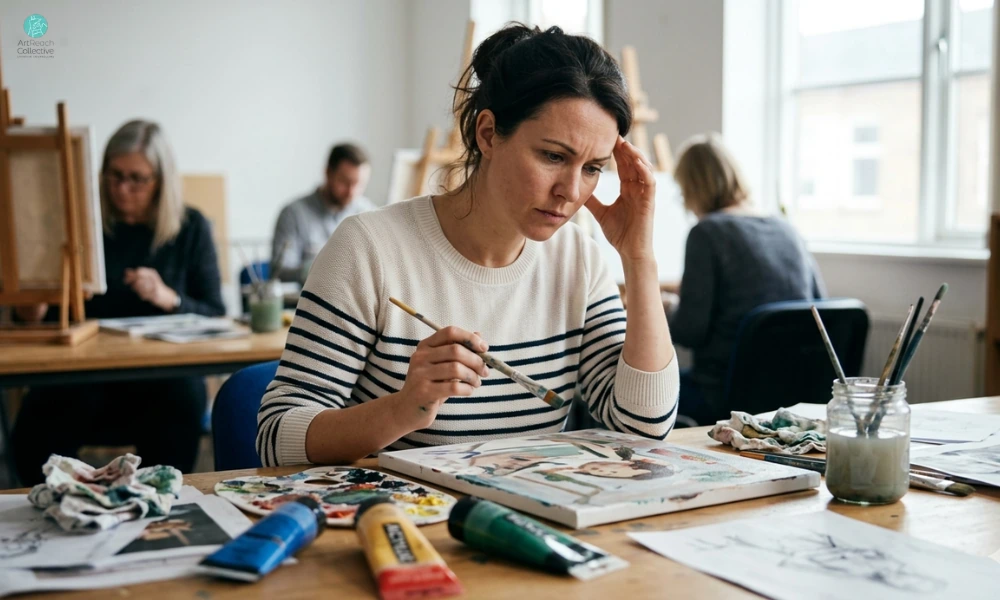
Learning to paint or draw as an adult is one of the most rewarding things you can do for your creative growth and mental wellbeing. But if you have ever picked up a brush and felt completely lost, you are not alone. Thousands of adult learners across Australia and around the world face real, deeply felt challenges when they step into the world of visual art for the first time, or return to it after years away.
This article breaks down the most common obstacles adult beginner art students face today, why these struggles happen, and what you can do to move through them with confidence.
Why So Many Adults Want to Learn Art But Feel Stuck
There is a quiet surge happening in adult art education. According to research in creative learning and wellbeing, more adults than ever are seeking out adult art classes, painting classes, drawing workshops, and creative expression as a way to manage stress, reconnect with themselves, and explore a new skill. Yet despite this growing interest, many adult learners drop out early or never even start because the emotional and practical barriers feel too high.
Understanding what those barriers are is the first step toward breaking them down.
The Biggest Obstacles Adult Art and Painting Students Face
Fear of Judgement and the Inner Critic
This is probably the number one issue for adult beginner artists. Children draw freely without worrying about what others think. Adults carry years of self-consciousness, comparison, and past experiences where someone said their work was not good enough.
This inner critic shows up the moment you pick up a pencil. It whispers things like “you are not talented,” “this looks terrible,” or “you are too old to start now.” Art psychologists call this creative self-doubt, and it is one of the most researched obstacles in adult learning environments. The fear of making mistakes leads to creative paralysis, which stops progress before it even begins.
The truth is, art is a skill, not just a talent. Like learning a language or playing an instrument, painting improves with practice, guidance, and repetition.
Comparison With Other Students or Professional Artists
Social media has made comparison culture worse than ever. Adult learners scroll through Instagram and Pinterest and see polished, professional artwork. They compare their first attempts to someone else’s tenth year of practice. This distorted comparison leads to discouragement, reduced motivation, and often, giving up entirely.
In a classroom setting, beginners also compare themselves to classmates who may have prior experience. This can feel deeply isolating, especially when you are trying something vulnerable like creating art.
Lack of Foundational Art Knowledge
Many adult learners come into painting with no understanding of the basics. They do not know about colour theory, value, composition, perspective, brush technique, or how different painting mediums like acrylic, watercolour, or oil behave differently on different surfaces.
Without this foundational knowledge, everything feels confusing and random. A painting that does not look right often comes down to something technical like incorrect values, muddy colour mixing, or no focal point, but the beginner does not know what went wrong or how to fix it.
This gap in visual art fundamentals is one of the most practical obstacles that structured art education can genuinely solve.
Not Enough Time to Practice
Adult life is busy. Between work, family, social obligations, and fatigue, finding consistent time to practice art feels almost impossible. Many adult students attend one class a week and then do not touch their supplies again until the next session.
Creative skill development requires regular practice. Without that repetition between lessons, progress feels slow, which leads to frustration and eventually quitting. Time management around creative hobbies is a real challenge for adult learners in a way that children enrolled in structured schooling simply do not face.
Choosing the Wrong Materials
Walk into any art supply shop and you are immediately overwhelmed. There are hundreds of brush types, dozens of canvas sizes, and paint ranges from student grade to professional grade at wildly different price points.
Many beginners buy cheap supplies that are genuinely difficult to work with, or they buy expensive materials they do not yet know how to use. The wrong brush for the wrong medium, or low-quality paint that behaves unpredictably, can make early learning unnecessarily hard.
Knowing which materials suit your chosen medium and skill level is something that good beginner art instruction covers, but self-taught learners often struggle with this for a long time.
Perfectionism and Unrealistic Expectations
Many adult beginners expect their first paintings to look like the reference image or the teacher’s demonstration. When they do not, they feel like a failure. This perfectionism is deeply tied to the adult need for competence and the discomfort of being a beginner.
Children are comfortable being beginners. Adults often are not. The expectation of fast results clashes with the reality that artistic development is a gradual, nonlinear journey. Letting go of perfectionism is an essential but often underestimated part of the adult art learning process.
Inconsistent or Unhelpful Instruction
Not all art classes are created equal. Some adult learners have been in classes where the instructor demonstrates and then leaves students to figure things out alone. Others have experienced overly critical feedback that crushed their enthusiasm, or feedback that was so vague it gave no real direction.
Adult learners need clear, encouraging, structured instruction that meets them where they are. They benefit enormously from understanding the why behind each technique, not just copying what the teacher does. When that quality of instruction is missing, progress stalls and motivation fades.
The Anxiety of Starting a New Creative Hobby as an Adult
There is a particular kind of vulnerability in picking up a new creative skill as a grown adult. You are used to being competent at things. Being a beginner again, especially in something as expressive and personal as art, can feel uncomfortable and even a little embarrassing.
Some people describe art class anxiety as similar to performance anxiety. There is a real neurological basis for this. When adults engage in unfamiliar creative tasks, the brain’s threat response can activate, making it harder to stay relaxed, open, and playful, which are all essential states for learning. In many ways, this experience overlaps with insights explored in mental health counseling classes, where emotional awareness and self regulation are key to overcoming fear and building confidence.
How to Move Past These Obstacles
Recognising the obstacle is half the battle. Here are practical ways adult learners can work through these common challenges.
Start with structured beginner instruction rather than trying to teach yourself from YouTube alone. Video tutorials are helpful supplements, but they cannot replace real-time feedback from an experienced teacher who can see your work and guide your specific development.
Set a realistic practice goal. Even thirty minutes two or three times a week between classes makes a significant difference in skill progression. Treat it like a habit, not a performance.
Keep a creative journal or sketchbook. Not everything needs to be a finished painting. Loose studies, colour mixing experiments, and rough sketches are all valuable practice without the pressure of producing a final piece.
Find a supportive learning community. Being around other adult beginners who are navigating the same challenges creates a sense of belonging and shared experience that is enormously motivating. The creative community is one of the most powerful antidotes to art anxiety.
Give yourself permission to make bad art. Deliberately create something messy on purpose. This small act breaks the perfectionism cycle and reminds you that the process, not the product, is where learning lives.
Frequently Asked Questions
Q: Is it too late to learn to paint as an adult?
A: Absolutely not. Many accomplished artists began painting in their thirties, forties, or even later. The adult brain is highly capable of learning new creative skills, and adult learners often progress faster than children because of their focus and motivation.
Q: How long does it take to get good at painting?
A: This depends on how often you practice and the quality of instruction you receive. Most adult beginners see noticeable improvement within three to six months of consistent practice and structured learning.
Q: What is the easiest painting medium for beginners?
A: Acrylic paint is widely recommended for beginners because it dries quickly, is easy to correct, works on most surfaces, and is less toxic than oil paint. Watercolour can be beautiful but is often less forgiving for absolute beginners.
Q: Why do my paintings always look muddy or flat?
A: Muddy colours usually come from overmixing or not understanding colour temperature and value contrast. Flat-looking paintings often lack tonal variation. These are foundational concepts that beginner instruction directly addresses.
Q: Do I need to be naturally talented to learn art?
A: No. Artistic ability is largely a learned skill. Research in art education consistently shows that structured practice, good instruction, and patience matter far more than innate talent.
A Final Word
The obstacles adult art and painting students face are real, but none of them are permanent. With the right environment, the right guidance, and a willingness to stay curious, every one of these barriers can be overcome.
If you are based in Melbourne and looking for a welcoming, structured space to begin or continue your creative journey, Artreach Collective offers for every age art classes designed specifically around how adult learners grow best, with supportive instruction, a genuine community, and a space where being a beginner is something to be celebrated.
The best time to start was years ago. The second best time is right now.